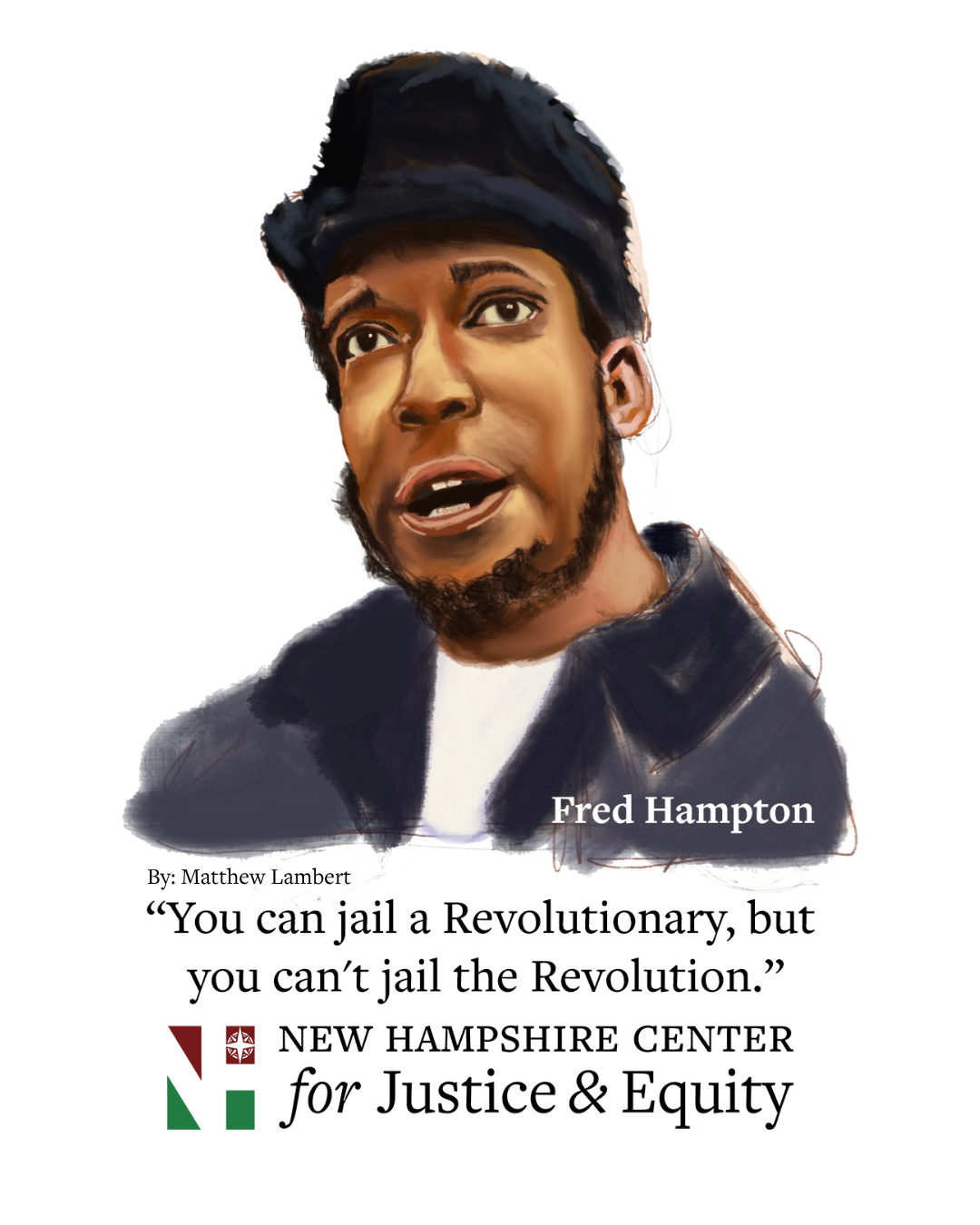
In our Icon Series, we give thanks to those whose lives have laid the foundation for our journey toward justice and equity. In this season of gratitude and reflection, the New Hampshire Center for Justice & Equity celebrates the extraordinary life of Fred Hampton.
About Fred Hampton
Sticker from NHCJE’s Icon Series, designed by Matt Lambert. Learn more.
Fred Hampton was a community organizer, civil rights activist, and leader of the Illinois chapter of the Black Panther Party. Known for his powerful public speaking and ability to build coalitions across racial and economic divides, Hampton worked to address poverty, racial discrimination, and police violence. At just 21 years old, he was killed by Chicago police during a raid connected to the FBI’s efforts to undermine the Black Panther Party. His death heightened the broader struggle against police violence and political repression, and his vision of community empowerment continues to inspire racial and economic justice movements today.
Early Life and Youth Activism
Fredrick Allen Hampton was born on August 30, 1948, to Francis and Iberia Hampton, though sources vary on his birthplace. Some accounts list Chicago, while others identify the nearby Illinois communities of Summit, Maywood, or Blue Island. A book about the Black Panther Party also identifies Shreveport, Louisiana, as his birthplace. Hampton grew up in Maywood, a predominantly Black suburb west of Chicago with an older brother and sister.
Hampton attended Irving Elementary School and Proviso East High School, excelling academically and athletically. As he became increasingly aware of the racial inequalities affecting his community, he took his first steps into community organizing by leading his high school's Interracial Committee.
As a teenager, Hampton also joined the National Association for the Advancement of Colored People (NAACP), eventually becoming president of its West Suburban branch's Youth Council. Under his leadership, the group grew to more than 500 members and advocated for better educational opportunities and recreational facilities for Black youth.
After graduating from high school, he enrolled in a pre-law program at Triton Junior College, but he changed course as his commitment to organizing and addressing systemic inequality became central to his life.
Community Empowerment in The Black Panther Party
In November 1968, Hampton joined the Black Panther Party, a political organization founded in Oakland, California, in 1966 by Huey P. Newton and Bobby Seale. The Party initially organized around armed self-defense against police brutality and expanded its work to include social programs addressing poverty, health care, education, and other unmet community needs.
Though young, Hampton quickly rose through the Party's ranks to become deputy chairman of its Illinois chapter. He helped organize a free breakfast program for children, which provided meals before school, and supported efforts to establish community health services. These initiatives reflected the Party's belief that addressing immediate needs and challenging structural inequalities were connected parts of the same struggle.
Hampton also advocated for political education and community participation. Through rallies, speeches, and neighborhood organizing, he encouraged residents to understand how public institutions and economic systems shaped their lives. His ability to communicate complex political ideas in accessible language helped him connect with people from different backgrounds and mobilize support for collective action.
Building Bridges Through the Rainbow Coalition
One of Hampton's most notable achievements was his role in developing the Rainbow Coalition, an alliance that brought together groups with different racial, cultural, and political identities around shared concerns, including poverty, inadequate housing, and police violence.
The coalition connected the Black Panther Party with the Young Lords, a Puerto Rican organization, and the Young Patriots Organization, a group of predominantly white, working-class people with roots in Appalachia. Hampton believed that communities could build greater political power by working together rather than allowing racial divisions to prevent cooperation.
His organizing attracted the attention of federal and local authorities. The FBI targeted the Black Panther Party through its Counterintelligence Program, known as COINTELPRO, which sought to disrupt and undermine political organizations through surveillance, infiltration, and other covert tactics. Hampton's growing influence and coalition-building efforts made him a particular focus of government surveillance, and in January 1969, Hampton was arrested on an old traffic warrant while appearing on television. Other Panthers were also persecuted around this time.
A Life Cut Short by Police Violence
On December 4, 1969, Hampton was killed at age 21 during a police raid on his apartment on Chicago's West Side. The officers entered the residence while Hampton was asleep next to his pregnant fiancée, Deborah Johnson, now known as Akua Njeri. Fellow Black Panther Mark Clark was also killed, and several others were wounded and arrested, with bail set at $100,000 each. His son, Fred Hampton Jr., was born 25 days after the assassination.
Subsequent investigations revealed serious discrepancies in the official account of the raid. Evidence showed that police fired approximately 99 shots, while only one shot came from those inside the apartment. Investigations also documented the FBI's involvement in efforts to undermine the Black Panther Party and the role of FBI informant William O'Neal, who had supplied information about Hampton and the apartment's layout. A civil lawsuit brought by the families and survivors was settled in 1982 for $1.85 million, with the city of Chicago, Cook County, and the federal government contributing to the settlement.
Hampton's death became a defining moment in the history of the Black Panther Party and the broader struggle against police violence. It sparked outrage in Chicago’s Black community and raised questions about government surveillance, political repression, and civil rights protections.
A Legacy of Solidarity and Collective Action
Despite his killing, Fred Hampton's legacy lives on through the community programs he helped establish, the coalitions he built, and the movements he inspired. More than 5,000 people attended his funeral at First Baptist Church of Melrose Park on December 9, 1969. In 1970, the public swimming pool in Maywood that Hampton had advocated for was named in his honor.
Hampton’s life and death were portrayed in the 1971 documentary The Murder of Fred Hampton, which examined his organizing and the circumstances surrounding his killing. The Chicago City Council later passed resolutions designating December 4 as Fred Hampton Day in both 1990 and 2004. More recently, the 2020 film The Trial of the Chicago 7 featured Kelvin Harrison Jr. as Hampton, and the 2021 film Judas and the Black Messiah, directed by Shaka King and starring Daniel Kaluuya as Hampton, brought his story to a wider audience.
Though his life was cut short at 21, Hampton’s work continues to inspire those fighting injustice, strengthening communities, and building a society where dignity, opportunity, and safety do not depend on race or economic status.
Learn More About Fred
https://www.biography.com/activists/a45988576/fred-hampton — Biography.com
https://worldhistoryedu.com/fred-hampton-life-activism-achievements-death/ — World History Edu
https://www.crsp.pitt.edu/fred-hampton — University of Pittsburgh School of Social Work Center on Race and Social Problems
https://blackpast.org/african-american-history/hampton-fred-1948-1969/ — Black Past
https://exhibits.stanford.edu/saytheirnames/feature/fred-hampton — Stanford University Libraries
Call to Action
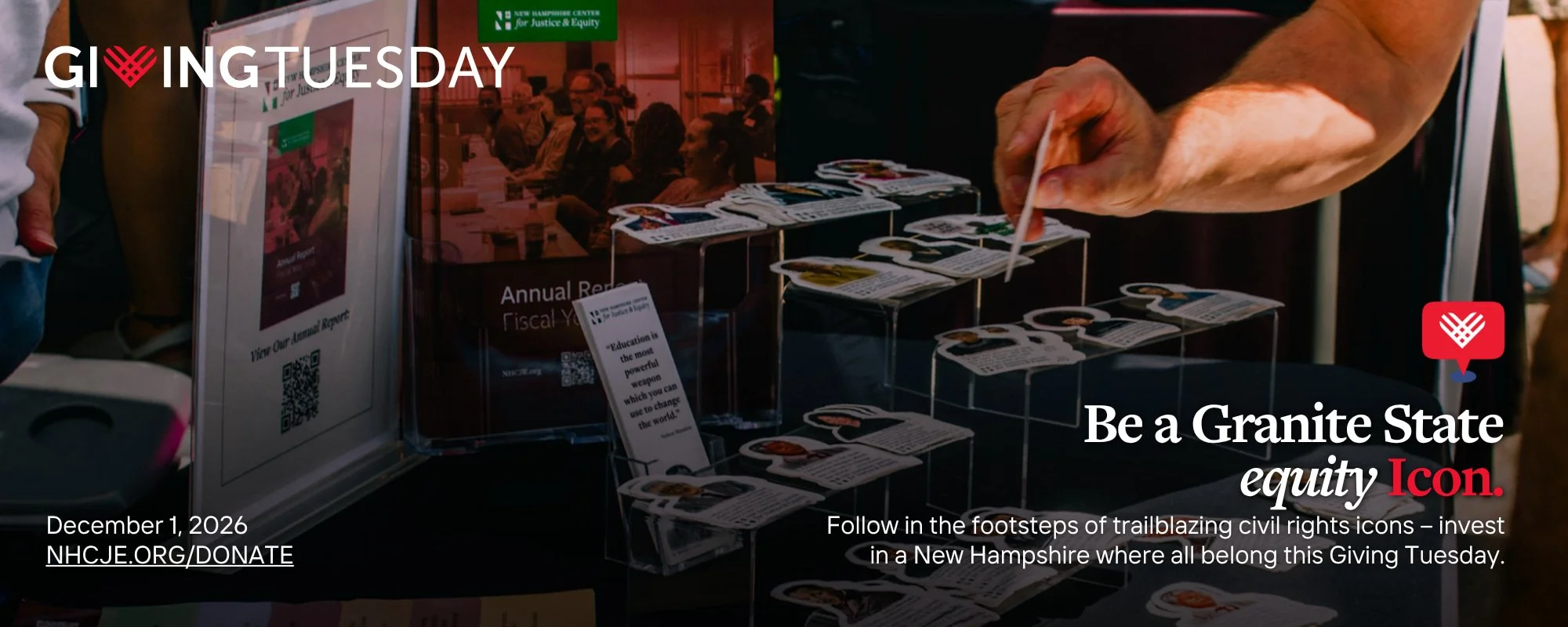
The work of advancing justice didn't begin with us, and it won't end with us. Building on the legacies of our Icons and all other advocates for justice who came before us, we invite you to help carry this work forward by investing in NHCJE this Giving Tuesday.
Learn more about NHCJE’s Icon Series