
Building Trust and Preserving Life: Six Policy Reforms for NH Law Enforcement
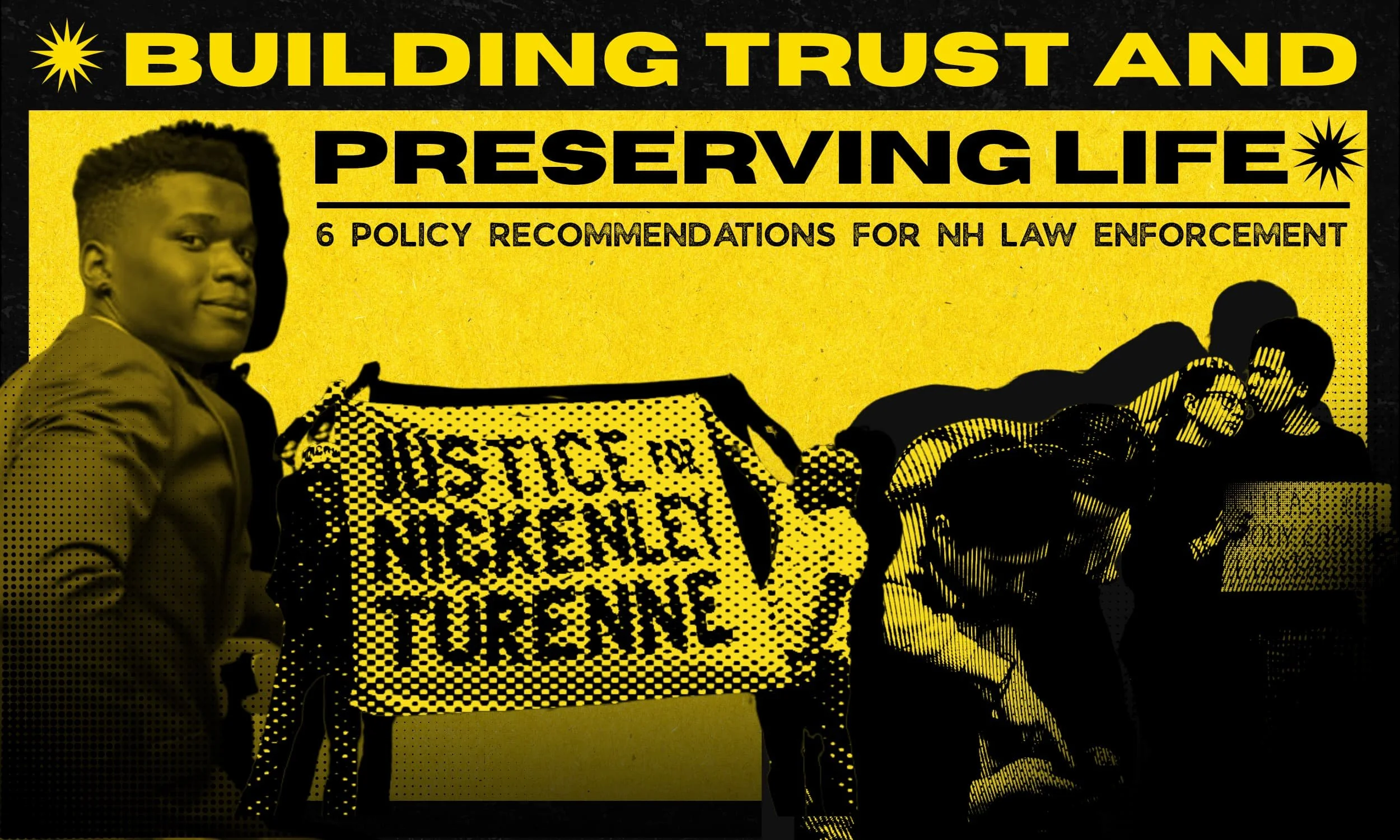
The NH Center for Justice & Equity, the NH Collective Power Coalition, and its partner organizations continue to mourn the loss of Nickenley Turenne at the hands of Manchester Police in the early morning hours of December 6, 2025.
Although the NH State Attorney General’s Office chose not to prosecute the officers involved in the shooting of Nickenley, we believe Nickenley’s life mattered and his death was preventable.
On July 1, the NH Attorney General’s Office issued a report concluding the officers' use of deadly force was legally justified under New Hampshire law because they reasonably believed Mr. Turenne posed an imminent threat.
On July 2, the NH Collective Power Coalition issued a response to the Attorney General’s disposition, recognizing that NH State Law establishes a high threshold for criminal prosecution of police officers and that the community remains deeply troubled by several aspects of this case. The concerns for the safety and well-being of our communities culminated in a series of mutually reinforcing policy recommendations brought forward by the Coalition.
These recommendations are consistent with the Commission on Accreditation for Law Enforcement Agencies’ (CALEA) standards. We believe that, when fully implemented, they will help ensure every Granite Stater returns home safely, including those sworn to protect and serve, while rebuilding trust and transparency between law enforcement and rural and urban communities across New Hampshire.
As NHCJE and the NH Collective Power Coalition continue to advocate for the systemic change required, we ground our work in rigorous research and contemporary best practices. Below are six mutually reinforcing policy recommendations that can lead to meaningful systemic reforms if fully resourced and implemented.
These combine increased behavioral health supports for law enforcement and impacted communities, with a fully resourced statewide agency with the authority to establish best practices, provide professional development opportunities and meaningful oversight.
Policy Recommendations
A fully resourced statewide agency, such as the New Hampshire Law Enforcement Accreditation Commission (NHLEAC), with the authority to accredit law enforcement agencies, establish statewide best practices, provide professional development, and ensure meaningful oversight.
Adoption of a universal statewide use of force policy that prioritizes de-escalation, proportionality, and preservation of life. In several states, the Attorney General has established a singular, uniform use-of-force policy that legally applies to every law enforcement agency within their respective state. Examples include New Jersey, Washington State, and Vermont.
Consistent statewide implementation and funding of crisis response, co-response models, and behavioral health partnerships to ensure mental health professionals play a central role in crisis response whenever possible. Generally speaking, New Hampshire has a strong foundation in Mobile Crisis Response Teams (MCRT), but the system faces adequacy issues, particularly regarding wait times for in-person mobile units or limited hours. NH’s crisis response network functions primarily through two avenues: Mobile Crisis Response Teams, including limited community-based Co-Responder Programs (i.e., Colorado), where law enforcement and mental health clinicians respond together, and Police Training Programs. Organizations like NAMI NH (National Alliance on Mental Illness) provide 40-hour Crisis Intervention Team (CIT) training courses across the state for police, fire, and EMS. These programs teach officers how to safely recognize a mental health crisis, de-escalate it, and connect individuals with proper treatment, emphasizing the need for supporting first responder behavioral health and wellness.
Guaranteed victim and family advocates for every family impacted by a police-involved shooting to ensure transparency, communication, and meaningful support throughout the investigative process. Some states provide victim advocates to support individuals and families affected by police-involved shootings; however, New Hampshire is not one of them. This type of victim and family support is typically provided by the state’s attorney general’s office, local prosecutor's office, or local law enforcement agencies.
Modification of the Manchester Police Department's Five-Day Return to Duty Policy following officer-involved shootings. The Manchester Police Department’s Five-Day Return to Duty Policy is inadequate by modern standards. The International Association of Chief of Policy guidelines and contemporary best practice lean heavily towards longer pauses paired with mandatory psychological evaluations and phased transition back to duty.
The Coalition recommends the Manchester Police Department model their Return to Duty Policy from the NH State Police’s Policy. State police policy requires officers involved in police involved shootings to take 30 days of leave after such an incident and not return to “active duty” until the investigation into the shooting has been completed.
Continued review and strengthening of police training related to implicit bias, de-escalation, communication, mental health response, and decision-making under stress. In July 2025, New Hampshire’s Legislature passed HB2, which included a ban on the use of state funds for DEI-related activities, including New Hampshire Police Standards and Training’s required implicit bias trainings. Although a federal judge in late 2025 issued a preliminary injunction on HB2’s DEI Ban and NH’s Police Standards and Training is not prohibited from providing implicit bias training(s), Director Scippa reports that such training is no longer required and alternative offerings are provided.
These reforms are not about being anti-police but rather about building systems that preserve life whenever possible. They are about equipping officers with better tools, strengthening public trust, improving accountability, and ensuring everyone, regardless of race, background, or mental health status, is afforded the dignity to survive an encounter with law enforcement.
We invite you to join us in this important work by sharing these recommendations with local and state policymakers, joining us for future community conversations, and speaking up for those who are unable to speak for themselves.
“Americans in all 50 states are not chanting in the streets, “Give us a commission, we want more data!” They’re chanting for real accountability, meaningful transparency, and an end to dangerous and excessive policing practices. ”