
Building a More Connected Crisis Response System in New Hampshire
This article is part of a series examining NHCJE’s and the NH Collective Power Coalition’s six policy reforms for law enforcement in New Hampshire. The recommendations were developed following the killing of Nickenley Turenne in late 2025 and the New Hampshire Attorney General’s Office’s subsequent decision not to prosecute the officers involved.
When someone experiencing a mental health or substance use crisis comes into contact with a first responder, the response can shape what happens next. Consistent statewide implementation and funding of crisis response, co-response models, and mental health partnerships can help ensure mental health professionals play a central role in responding to people experiencing a crisis.
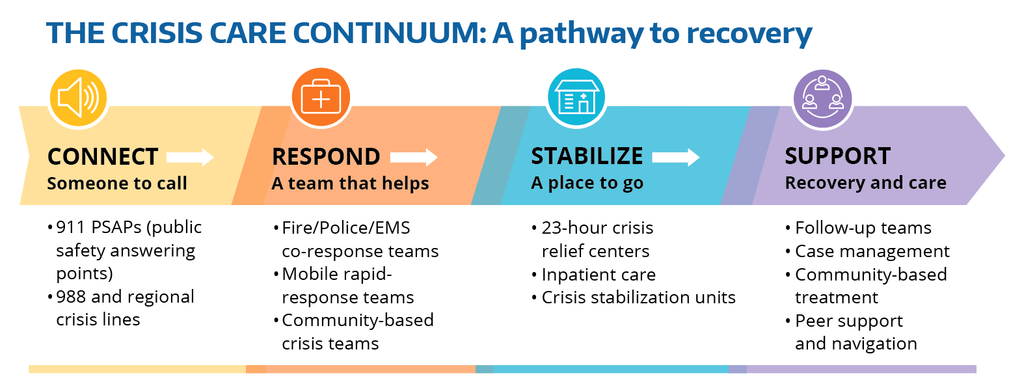
Over the past several years, New Hampshire has built a system that gives first responders alternative options to responding to crisis situations, seeking to preserve life whenever possible. The state’s Rapid Response Access Point (NHRRAP) can dispatch mobile crisis response teams that bring in behavioral health professionals to respond in the community and connect people to appropriate care.
The New Hampshire Center for Justice & Equity (NHCJE) spoke with Jessica Lachance, Director of the Mental Health Center of Greater Manchester's Rapid Response Team, and Susan Stearns, Executive Director of NAMI New Hampshire (National Alliance on Mental Illness), about the connections between law enforcement and behavioral health providers, and the challenges of creating a consistent system across a geographically and demographically diverse state.
Manchester’s Rapid Response Model
The Mental Health Center of Greater Manchester launched its Rapid Response Team in 2016, providing 24/7 community-based responses to people experiencing mental health or substance use crises. The team, including a master's-level emergency clinician and a certified peer support worker with lived experience, receives referrals from police departments, community members, providers, and community partners.
Until 2022, Manchester was one of only three communities in New Hampshire with a mobile crisis team, alongside Concord and Nashua. A statewide expansion brought the model to all 10 community mental health centers in New Hampshire. The New Hampshire Rapid Response Access Point (NHRRAP) now provides a centralized access point to triage calls around the clock.
Manchester offers one example of what effective co-response models can look like. Jessica Lachance, Director of the Mental Health Center of Greater Manchester's mobile crisis response team, said that the existing relationship with the Manchester Police Department helped shape the team’s approach from the start.
“Because of our community relationship with the Manchester Police Department, we intentionally brought in law enforcement officers to be embedded in our teamwork with us,” she noted.
Unlike models in which a clinician is embedded within a police department—like Police Social Work—Manchester includes an officer as a member of the mental health center's team. Only officers who have completed Crisis Intervention Team (CIT) training are eligible for the detail.
“Because of our community relationship with the Manchester Police Department, we intentionally brought in law enforcement officers to be embedded in our teamwork with us.”

Image: NAMI NH
Preparing First Responders for Behavioral Health Crises
CIT gives law enforcement officers and other first responders additional skills for recognizing and responding to people experiencing mental health or substance use crises. The model was developed by the Memphis Police Department in partnership with NAMI Memphis nearly three decades ago, following a fatal encounter between police and a community member experiencing a mental illness crisis. The 40-hour training has since become an established model for crisis response training.
NAMI New Hampshire began bringing Crisis Intervention Team training to the Granite State through a federal grant approximately eight years ago. The program has since received additional state support, including funding through the New Hampshire Police Standards and Training Council (PSTC).
“Over 1,320 first responders have been trained through NAMI NH's CIT program as of our most recent count,” noted NAMI Executive Director Susan Stearns. “Approximately two-thirds are law enforcement officers, with fire and EMS personnel, corrections officers, and, occasionally, mobile crisis staff also participating.”
The curriculum covers different types of mental illness and how they may present, communication and de-escalation techniques, and scenarios that allow participants to practice responding to situations they may encounter in the field. For first responders who cannot realistically commit to a 40-hour training, particularly volunteer or part-time fire and EMS personnel, NAMI New Hampshire also offers an eight-hour Mental Health First Aid for Public Safety course. Stearns emphasized that this program is intended to complement, rather than replace, CIT.
But training is only one part of preparing communities to respond effectively to behavioral health crises. “Training alone does not necessarily make you able to respond well in these situations,” Stearns said. “Department culture, available resources, protocols and individual circumstances all play a role.”
“Training alone does not necessarily make you able to respond well in these situations. Department culture, available resources, protocols and individual circumstances all play a role.”
The Challenge of Building a Statewide Response
Expanding mobile crisis response statewide has not meant that every community immediately developed the same relationships with law enforcement. The 10 community mental health centers serve regions with very different populations, geography, and available resources.
In rural areas, a team may need to travel more than an hour within its service area to respond to a call. In those settings, a clinician may participate remotely by video while a peer support worker and law enforcement officer go to the person's location. A community may also rely on a combination of support from sheriff's departments, state police, fire and EMS agencies, dispatchers and other partners.
But building those partnerships takes time. Lachance said there was some resistance as the statewide model was introduced, including the need to demonstrate to law enforcement that calling a mobile crisis team could add to the capacity of police departments by redirecting crisis needs to mental and behavioral health professionals. Stearns noted that partnerships do not look the same everywhere. “There are some community mental health centers that are very comfortable going out with law enforcement, and there are some that are a little more cautious,” she said.
To address this, relationship-building efforts in Manchester include officers who have become champions of CIT and mobile crisis response, sharing the department’s experience with other agencies. The state has also created learning collaboratives and a monthly subcommittee that brings together law enforcement, first responders, mobile crisis teams, the statewide access point, and others involved with 988. These forums provide opportunities to identify barriers and develop solutions across communities.
Supporting People Beyond the Initial Response
The development of mobile crisis response, NHRRAP, Crisis Intervention Team training, police social workers, and other behavioral health partnerships represents a broader shift in how communities and law enforcement can respond when someone is experiencing a mental health or substance use crisis.
For Lachance, the value of the model can be measured not only by whether someone avoids an emergency department or arrest, but also by what happens next: whether the person gets connected to treatment, a relationship with a provider is established, and future crises can be averted or addressed differently.
The financial implications are also significant. Using a conservative estimate of $6,850 in community costs for an emergency department visit, Lachance cited an analysis from the Mental Health Center of Greater Manchester that estimated its diversions in 2025 represented approximately $7.9 million in avoided emergency department costs.
The team's impact also extends to people who are already involved with the criminal-legal system. In Manchester, mobile crisis staff can respond to the police department's bookings when someone in custody may be experiencing a crisis. They can assess the person and make recommendations, including facilitating a transfer to a hospital when appropriate. The team also works with the Hillsborough County House of Corrections on crisis response and transitions from incarceration.
Continuing to Build the Crisis Response System
Manchester’s experience illustrates what sustained partnerships can make possible, but both Lachance and Stearns emphasized that New Hampshire’s statewide mobile crisis system is still developing, particularly as communities build relationships with their local law enforcement and behavioral health partners.
For NAMI New Hampshire and the Mental Health Center of Greater Manchester, the goal is to create systems in which the right professionals can combine behavioral health expertise and public safety resources to respond to the needs of people in crisis.
That work will require continued investment in staffing, training, and infrastructure. Stronger coordination among community mental health centers, law enforcement, 988, emergency services, and other community partners can help ensure that people experiencing a crisis are connected to the appropriate response, wherever they live.
This article is part of a series examining NHCJE’s and the NH Collective Power Coalition’s six policy reforms for law enforcement in New Hampshire. Read more:


September is both Suicide Prevention Month and National Recovery Month. If you or someone you know is experiencing a mental health or substance use crisis in New Hampshire, call or text 988 or call the New Hampshire Rapid Response Access Point at 833-710-6477, available 24/7.
For additional non-crisis mental health resources and support, NAMI New Hampshire’s Information & Resource Line is available weekdays at 1-800-242-6264, press 4, or info@naminh.org.
About Jessica Lachance

Jessica Lachance is the Director of Rapid Response and Transitions Services with the Mental Health Center of Greater Manchester. She has been employed by MHCGM for 28 years, serving various roles in community support programs, and is a founding member of the Mobile Crisis Response Team since its inception in 2016. Jessica has participated in the Manchester Police Department Crisis Intervention Training and Certification since 2016 and has been a guest trainer for the NAMI Crisis Intervention Training for the past 7 years. Jessica serves on several Statewide collaboratives and subcommittees aimed at improving the State of NH's crisis response system. Jessica is also certified in Critical Incident Stress Management and is a member of the State of NH Disaster Behavioral Health Response Team.
About Susan Stearns

Susan Stearns is Executive Director of NAMI New Hampshire, a role she has held since January 2022 after serving as the organization’s Deputy Director. She has worked with NAMI New Hampshire for over a decade, and in New Hampshire’s nonprofit sector for more than 30 years, advocating for families, children, and people with disabilities. Her personal experience advocating for loved ones in the child and adult mental health systems informs her commitment to improving New Hampshire’s mental health care system. Currently, she is a member of the Governor’s Commission on Disability, the Oversight Commission on Children’s Services, the Commission to Study the Incidence of Post-Traumatic Stress Disorder in First Responders, and the New Hampshire Children’s Health Foundation.