
20 Years in the Making: How New Hampshire Got to Recognizing Martin Luther King Day
At a time when civil rights protections are under renewed scrutiny nationally and in the Granite State, the hard-fought journey to recognizing Martin Luther King Day in New Hampshire offers valuable lessons. The New Hampshire Center for Justice & Equity (NHCJE) spoke with Arnie Alpert, an organizer of the Martin Luther King Day Committee, about the two-decade-long grassroots movement that ended New Hampshire’s lone stance against recognizing Martin Luther King Jr.'s birthday as a holiday.
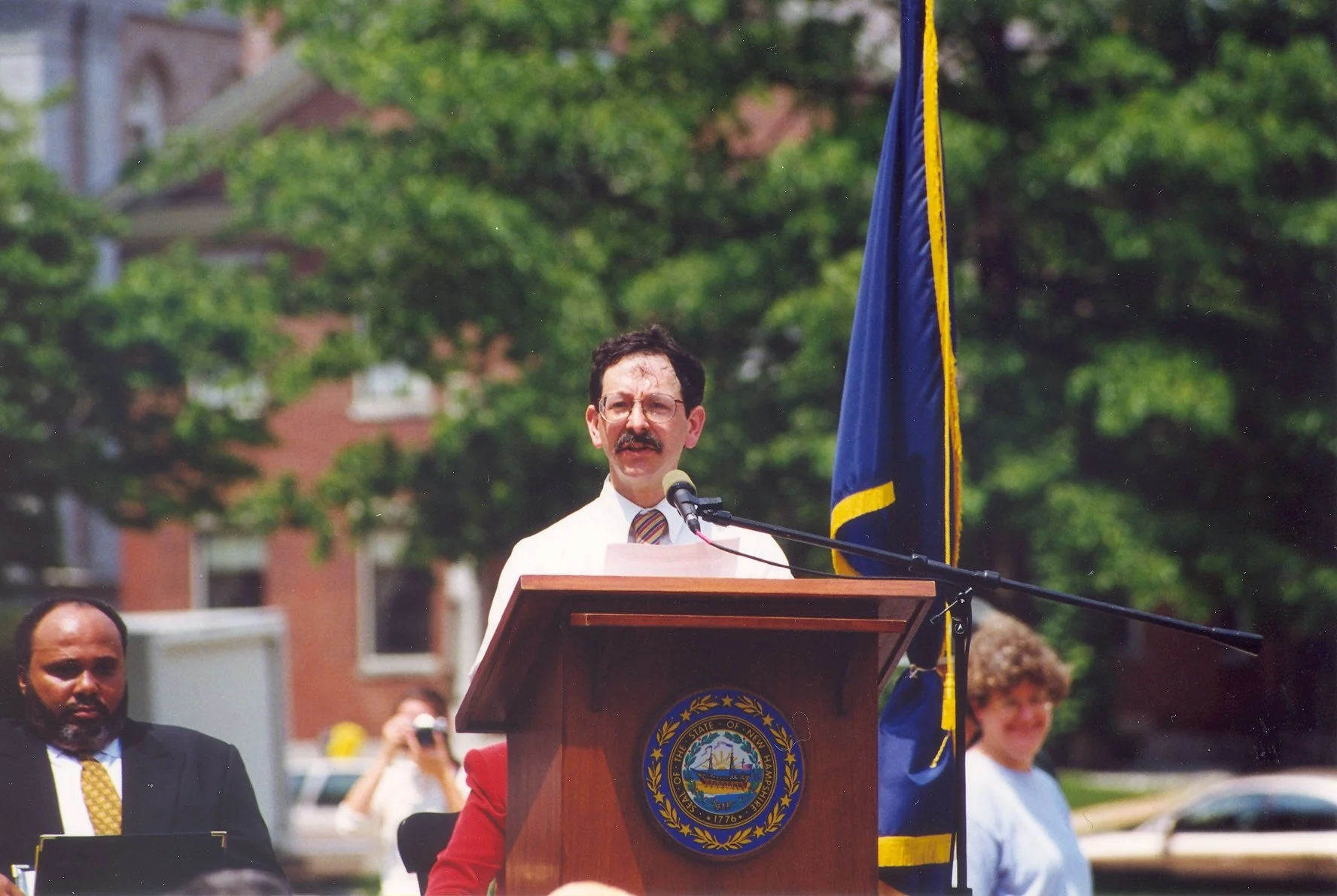
Photo provided by Arnie Alpert from the signing ceremony on June 7th, 1999. Pictured is Arnie speaking.
A National Holiday Meets Resistance
The story began four days after Dr. King's assassination on April 8, 1968, when Congressman John Conyers from Detroit introduced legislation to make the civil rights leader's birthday, January 15th, a national holiday. “Conyers introduced that bill every year for 15 years, but it never really went anywhere,” Alpert started.
In 1983, following advocacy by Coretta Scott King, who encouraged groups around the country to hold observances of her late husband, and momentum from Stevie Wonder's hit song "Happy Birthday," Congress finally passed the legislation. The holiday was signed into law by President Ronald Reagan and scheduled to take effect in 1986.
“I just never understood
How a man who died for good
Could not have a day that would
Be set aside for his recognition ”
Most states quickly followed suit, and by the time the federal holiday was first observed on the third Monday of January, 1986, only four states held out: Utah, Arizona, South Carolina, and New Hampshire.
The Movement Takes Root in New Hampshire
Even before the federal holiday was established, Portsmouth Senator Jim Splaine proposed the first legislation to create a state holiday honoring Dr. King in New Hampshire in 1979. And while the legislature would repeatedly reject the holiday, in 1983, the Manchester NAACP branch president, Lionel Johnson, brought together leaders of the Manchester YWCA and the Greater Manchester Black Scholarship Foundation to organize the city's first Martin Luther King birthday celebration at Brookside Congregational Church. “Despite a major blizzard, people came,” recalled Alpert.
By 1984, the Martin Luther King, Jr. Coalition had formed, and the three original groups were joined by the American Friends Service Committee, the Manchester Education Association, the State Employees Association, and other civic organizations.
In Portsmouth and Nashua, similar community gatherings and breakfasts took shape, backed by congregations, local groups, unions, educational institutions, and social justice advocates. As these annual events gained traction across the state, uplifting celebrations and amplifying public awareness of the need for official holiday recognition, the opposition grew louder.
An Editorial Crusade Against MLK Day
Adding to repeated defeats at the State House, the Union Leader launched an editorial campaign that would last for years, attacking Dr. King, the holiday, and its supporters. Chief editorial writer Jim Finnegan relentlessly argued that King didn't deserve recognition due to his “treasonous opposition” to the Vietnam War and alleged links with the Communist Party.
While other newspapers and regional dailies across the state published editorials supporting the holiday, the Union Leader's influence as the only statewide morning newspaper took precedence. In response, Alpert challenged these articles on behalf of supporters with facts and truth-telling, informed by biographies about Dr. King, books about the Civil Rights Movement, documentaries, speaker tours, and seminars.
“Each time they published an editorial, I had to figure out whether what they were saying was true, a distortion, or an outright lie,” he recalled. “In the process, I became much more appreciative and devoted to Dr. King’s method of promoting change. That had a transformative effect on me as an organizer.”
“In the process, I became much more appreciative and devoted to Dr. King’s method of promoting change. That had a transformational effect on me as an organizer.”
A New Phase of Organizing and Statewide Mobilization
When, in 1987, Martin Luther King Day supporters introduced the budget-neutral idea of observing the holiday instead of Fast Day – an obscure holiday dating back to the late 1800s which observed a fast called by New Hampshire's religious leaders in 1681 to pray for the recovery of the first colonial governor, John Cutt – opponents to Martin Luther King Day discovered a passionate attachment to this archaic holiday and voted against the bill.
By 1988, members of the Martin Luther King, Jr. Coalition realized a more concerted effort was needed to win support from a majority of legislators and whoever was the governor. Lionel Johnson successfully ran for office as a State Representative, to advance the holiday from within and following a meeting with representatives of groups that had been holding King Day events in Nashua and Portsmouth, the Martin Luther King Day Committee was formed.
Alpert, who worked as New Hampshire Program Director for the American Friends Service Committee at the time, helped coordinate the emerging movement alongside Lionel Johnson, Algene Bailey, and Will Thomas. The group would gain backing from the state's two NAACP chapters, the New Hampshire Council of Churches, Linda Gathright and the Southern New Hampshire Outreach for Black Unity, the New Hampshire AFL-CIO, the New Hampshire Women's Lobby, the NH branch of the National Education Association, and even Digital Equipment Corporation, then the state’s largest private employer.
Marches and rallies were held in Concord, petitions were circulated, and when public hearings were held, hundreds of people showed up to testify. “If you're working against the tide, you need people to be organized, to be vocal, and to be present,” Alpert emphasized.
Others who played important roles at different moments of this broad effort included Anne and Stan White, who organized local observances in Portsmouth, and State Representatives such as Harvey Keye and Jackie Weatherspoon, Rev. Lillian Buckley, whose music became an anthem for the movement, Rev. Dr. Arthur Hilson of New Hope Baptist Church in Portsmouth, Juanita Bell, Sandra Hicks, T.J. Wheeler, Mike Clemens, Valerie Hansard, Rev. Gloria Holmes, Valerie Cunningham, and Thomasina Downing.
“If you’re working against the tide, you need people to be organized, to be vocal, and to be present.”
Momentum Builds as the State Seeks a Workaround
The campaign intensified in 1989 when Senator Susan McLane and Representative Linda Long, the first Black woman to serve in the legislature, once again, though unsuccessfully, tried to swap Fast Day for Martin Luther King Day.
In the same year, Vanessa Johnson, daughter of NAACP leader Lionel Johnson, was elected to the Manchester School Board, becoming its first Black member. She introduced a proposal to make Martin Luther King Day a school holiday in Manchester. It passed, but not without strong opposition from the movement’s most active antagonist, the Union Leader newspaper.
Despite the backlash, local school districts continued to observe Martin Luther King Jr. holidays, thereby increasing the movement’s momentum. By 1990, 35 school districts observed the holiday, up from 12 the previous year. “High school students in four different schools in New Hampshire, independently decided to stage walkouts on Martin Luther King Day,” Alpert recounted. “These kids knew it was important and stood up for it through Kingian civil disobedience.”
By 1991, Republican state representative Jackie Domaigne introduced alternative legislation backed by the Union Leader to eliminate Fast Day and create a Civil Rights Day in April. With no connection between April and civil rights, the proposal evolved to keeping the name Civil Rights Day but observing it on the same January date as the federal Martin Luther King Day.
“It was very obvious to everybody that the point was to avoid naming Dr. King while allowing New Hampshire to signal that it wasn’t a racist state, because how can we be a racist state if we have a holiday for civil rights?” noted Alpert. “But from a political perspective, it could just as easily have been named, ‘Not Martin Luther King Day’.”
Despite years of resistance, compromise presented a way forward. Lionel Johnson and Juanita Bell, two Black state representatives who had been at the founding of the Martin Luther King Day movement, voted to pass this legislation. While the rest of America observed Martin Luther King Day, New Hampshire observed Civil Rights Day.
The Final Push Toward Martin Luther King Day
For the next eight years, the Committee chased a new horizon: to rename the ambiguous holiday as Martin Luther King Jr. Civil Rights Day. Efforts to explicitly honor Dr. King were repeatedly blocked by the House, even as the Senate approved bills to add his name and Governor Steve Merril issued annual proclamations recognizing Martin Luther King Jr. Civil Rights Day.
During that time, New Hampshire and Arizona were the only two states that didn't have a holiday honoring Dr. King. Arizona faced boycott pressure over its refusal to recognize the holiday, particularly when selected to host the Super Bowl, and finally adopted Martin Luther King Day in 1993, leaving New Hampshire as the sole holdout.
However, the Committee deliberately chose not to make embarrassment or shame their primary message. “This was about who Martin Luther King Jr. really was and what he stood for: a leader who challenged racism, extreme materialism, and militarism, who insisted on nonviolence, who showed extraordinary courage in the face of threats, and who worked to bring people together around a vision of justice, peace, and shared humanity,” Alpert highlighted.
Other legislative attempts to rename the holiday failed again and again. Things changed after Governor Jeanne Shaheen was reelected in 1998. With changes in legislative leadership and renewed grassroots pressure, two bipartisan bills to formally establish Martin Luther King Jr. Civil Rights Day gained overwhelming support in the House and the Senate. In 1999, the Senate passed SB 80 by a vote of 19 to 5, and the House passed HB 68, 212-148, after a long debate and a powerful speech from Representative Harvey Keye about growing up in segregated Birmingham and the impact of Dr. King's leadership.
“This was about who Martin Luther King Jr. really was and what he stood for: a leader who challenged racism, extreme materialism, and militarism, who insisted on nonviolence, who showed extraordinary courage in the face of threats, and who worked to bring people together around a vision of justice, peace, and shared humanity.”
The Legacy of an Earned Victory
The bill was signed into law by Governor Jeanne Shaheen on June 7, 1999, culminating nearly two decades of organizing, demonstrations, petitions, student-led rallies, and public testimony. New Hampshire observed Martin Luther King Jr. Civil Rights Day for the first time on January 17, 2000.
“We had no idea it would take this long. Over the years, we were joined by thousands of New Hampshire people, Black and white, young and old, women and men, religious and secular, straight and gay, natives and move-ins, labor and business, left-wingers and right-wingers, citizens, legislators, and governors, all of whom found something in Dr. King that made them believe New Hampshire would benefit from a holiday in his name.”
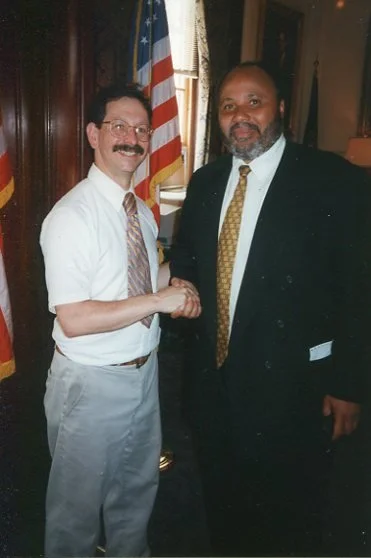
Photo provided by Arnie Alpert from the signing ceremony on June 7th, 1999. Martin Luther King III and Arnie.
What started as a battle to implement a holiday became a lesson in how social movements transform communities through sustained organizing, education, and engagement. “In most states, Martin Luther King Day was simply adopted without controversy, another day off marked on calendars. In New Hampshire, because we had to fight for it so much, simply observing Martin Luther King Day felt like an act of defiance,” stated Alpert.
By way of this campaign, thousands of Granite Staters learned about Dr. King's philosophy of nonviolent resistance, his pursuit of racial and economic justice, and his methods of creating change. For Alpert, internalizing Dr. King’s teachings means embracing love and mutual respect, even in the face of hostility, and using those values as tools for unity and solidarity in times of increasing division.
While we’re seeing renewed attacks on civil rights protections – including attacks on trans community members, efforts to undermine constitutional protections for immigrants, and attempts to ban diversity, equity, and inclusion (DEI) programs in K-12 public schools and public and private universities (recently blocked by the New Hampshire federal court) – the hard-won battle to celebrate Martin Luther King Day in the Granite State reminds us that progress is neither immediate nor permanent. It must be defended, renewed, and celebrated year after year as our collective commitment to justice, equity, and a future where all people can thrive.
“Human progress is neither automatic nor inevitable. Even a superficial look at history reveals that no social advance rolls in on the wheels of inevitability. Every step toward the goal of justice requires sacrifice, suffering, and struggle; the tireless exertions and passionate concern of dedicated individuals. ”
One of several Martin Luther King Day events across NH, the 2026 annual MLK, Jr. Community Celebration, “Uplifting Resistance through Community,” will take place on Monday, January 19, 2026, 11:00 am to 4:00 pm at Memorial High School, 1 Crusader Way, Manchester, NH 03103.
About Arnie Alpert

Arnie Alpert. Image Credits: American Friends Service Committee
Arnie Alpert is a long-time activist/organizer in movements for peace and social/economic justice. After serving on the staff of the Clamshell Alliance from 1978 to 1979, he served as the co-director or director of the American Friends Service Committee’s New Hampshire Program from 1981 until his retirement in 2020. In that position he played a leadership role in the campaigns to establish a state holiday named for Martin Luther King, Jr. and to repeal the state’s death penalty. Over the years, he trained hundreds--or perhaps thousands--of people in nonviolent techniques, including conflict de-escalation, “bird-dogging” presidential candidates, and civil disobedience, wrote numerous articles for New Hampshire newspapers and other publications, and hosted a weekly radio show on WNHN-LP for eight years.
Arnie is known for combining action with education, for example using arrests for anti-sweatshop leafletting at a shopping mall to raise awareness about the impact of neoliberal globalization on workers and freedom of speech, and cosponsoring establishment of a historical marker for labor shero Elizabeth Gurley Flynn near her Concord birthplace.
Over the years, Arnie won awards from groups including the Granite State Organizing Project, Manchester NAACP, the Martin Luther King Coalition, the NH AFL-CIO, the NH Women’s Lobby, the ACLU of New Hampshire, Rivier University, and Keene State College.
Since retirement in 2020, he has written a column, “Active with the Activists,” for InDepthNH.org, covering topics such as labor organizing, immigrant solidarity, climate action, and anti-war movements. Arnie also created a website, nhradicalhistory.org, which has about 30 stories about people, organizations, and movements that have stirred things up in the Granite State.
Arnie is a member of the National Writers Union. He lives in Canterbury with Judy Elliott.