2025: Strengthening Impact and Building What Comes Next
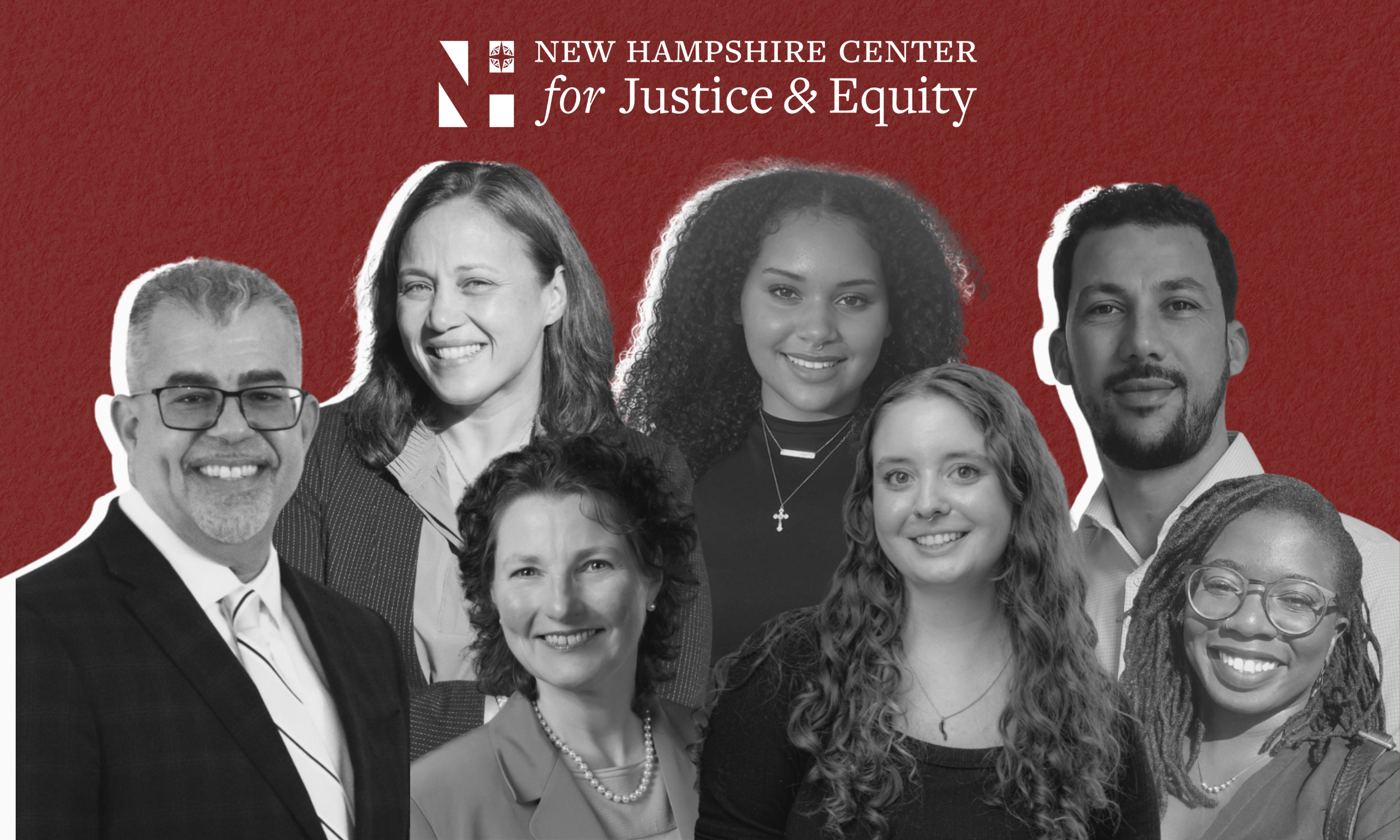
The NHCJE Staff. From left to right: Anthony Poore, Jo Porter, Marie Tule, Ayvah Collier, MG Benjamin, Amine Tabet, Grace Kindeke.
As 2025 comes to a close, the New Hampshire Center for Justice & Equity (NHCJE) reflects on a year marked by growth, deepened partnerships, and new ways to be grounded in community. This year included intentional preparation to strengthen and invest in our infrastructure, expansion of the organization’s reach, and continued work advancing equity, justice, and opportunity across the Granite State.
Laying the Groundwork for the Future
While NHCJE did not add new members to its Board of Directors this year, significant work took place behind the scenes to prepare for the next chapter of leadership. One of the most exciting milestones of 2025 was the completion of NHCJE’s Community Advisory Board charter. Launching early next year, this new advisory body will consist of regionally-based community members who are deeply engaged in on-the-ground work across New Hampshire.
The Community Advisory Board will help inform NHCJE’s programming and policy priorities through lived experience. This initiative reflects NHCJE’s belief that effective and lasting change begins with those closest to the issues, and that input from the community will bolster our work.
Investing in People and Community Space
This year also brought meaningful growth to NHCJE’s team. The organization welcomed Amine Tabet as an Administrative Coordinator, Grace Kindeke as Director of Projects, and Ayvah Collier, a senior at Manchester’s Memorial High School, as our 2025 - 2026 Academic Intern. Each has brought energy, insight, and capacity, strengthening NHCJE’s ability to respond to community needs.
The summer of 2025 was marked by the move into NHCJE’s new headquarters in the heart of Manchester. This has allowed the organization to accommodate the expanded team, host community partners, and create a shared space for collaboration.
“Our headquarters are already serving as a gathering space for partners who otherwise lack access to meeting facilities, reinforcing our commitment to being a community resource,” highlighted Anthony Poore, NHCJE’s President and CEO. “And from a financial perspective, this was essentially a budget-neutral move,” he added. The new office doubled the organization’s footprint while reducing our facilities’ costs by 50%.
“Our headquarters are already serving as a gathering space for partners who otherwise lack access to meeting facilities, reinforcing our commitment to being a community resource.”
Research That Informs Action
Throughout 2025, NHCJE also continued to advance community-based research that shines a light on inequities and equips advocates and policymakers with actionable data. In partnership with New Hampshire Housing, the organization released a report on the Challenges to Homeownership in New Hampshire. The report found that while 72 percent of White households in New Hampshire own their homes, only 33 percent of Black households do, a gap wider than national averages.
“The big takeaway is that homeownership rates across New Hampshire are not equal, and they're definitely not equitable,” said Poore. “The racial disparities in homeownership rates are the largest contributor to our Nation’s racial wealth gap, and New Hampshire's got a lot of work to do.”
NHCJE also updated its Race and Ethnicity in New Hampshire data brief, ensuring that timely, accessible demographic data remains available to communities across the state.
“The big takeaway is that homeownership rates across New Hampshire are not equal, and they’re definitely not equitable. The racial disparities in homeownership rates are the largest contributor to our Nation’s racial wealth gap, and New Hampshire’s got a lot of work to do.”
Community Building and Collective Power
Across its program pillars, NHCJE remained deeply engaged in community-building and organizing. In 2025, the organization actively participated in several coalitions, including the Freedom to Read Coalition, the Education Coordination Roundtable, and the New Hampshire Voting Rights Coalition.
A standout effort was the leadership provided by Jo Porter, NHCJE’s Chief Strategy Officer, in coordinating and supporting a coalition to respond to statewide Diversity, Equity, and Inclusion (DEI) rollbacks. “Her work was instrumental in organizing impacted stakeholders and community based organizations, sharing information, and supporting advocacy efforts that contributed to the ACLU of New Hampshire securing a preliminary injunction blocking a new state law that banned DEI programs in New Hampshire's K-12 public schools and universities,” noted Poore.
Another 2025 milestone was the convening of a “Collective Power Group”, developed and supported by NHCJE, BLM-NH, Business Alliance for People of Color (BAPOC), Black Heritage Trail NH, and Therapists of Color New England. This Collective convenes a broad set of stakeholders in BIPOC, LGBTQIA+, Disability leaders and organizations from across the state in response to the shifting national and local political landscape.
Now organized by Grace Kindeke, NHCJE’s Director of Projects, the group convenes regularly and focuses on public and political engagement, cross-regional collaboration, and intentional care for mental and emotional well-being. This initiative represents both resilience and possibility heading into 2026.
“Her work was instrumental in organizing impacted stakeholders and community based organizations, sharing information, and supporting advocacy efforts that contributed to the ACLU of New Hampshire securing a preliminary injunction blocking a new state law that banned DEI programs in New Hampshire’s K-12 public schools and universities.”
Building Capacity, Protecting Rights, and Investing in Community
Similar energy was put into the “institutional capacity-building” and “intentional investments” program pillars. NHCJE continued its capacity-building work through participation in the State of New Hampshire’s Juvenile Justice Subcommittee on Racial and Ethnic Disparities and through targeted trainings and partnerships.
As part of this work, NHCJE partnered with local organizations, including the ACLU of New Hampshire and the Granite State Organizing Project, to bring “Know Your Rights” training to the community.
At the same time, NHCJE leveraged interest income from its investments to distribute approximately $10,000 in small, community-based sponsorships, supporting local arts initiatives, neighborhood convenings, community events, and mutual aid efforts. These investments ranged from public mural projects to direct support, including a turkey giveaway that helped dozens of families across the state receive holiday meals.
In addition, NHCJE continued to serve as a fiscal sponsor for five mission-aligned initiatives, including an arts-based disability inclusion project, a pedestrian transportation initiative, a documentary film exploring the myth of meritocracy, and a growing podcast platform. “Supporting small, community-based projects helps ensure our work stays connected to the people and places we serve,” said Poore.
“Supporting small, community-based projects helps ensure our work stays connected to the people and places we serve.”
Gathering, Storytelling, and Looking Ahead
NHCJE’s Annual Meeting brings together partners, supporters, and community leaders for reflection and connection. This year’s event was the largest to date, where more than 140 changemakers from across New Hampshire gathered in Laconia to harness collective strengths. Planning is already underway for the 2026 Annual Meeting, scheduled for Tuesday, May 12, 2026, in Portsmouth.
This year also saw continued growth in NHCJE’s communications and media presence. Website traffic doubled year over year, social media engagement continued to climb, and the annual NHCJE Icons Series sparked meaningful conversations. Through consistent blogging and storytelling that centered community voices and highlighted the work of partners with shared missions, amplified the people and organizations helping to drive equity and justice across New Hampshire.
As we close out 2025, NHCJE is grateful for the community, partners, and funders that sustain this work and offer clarity about where the organization is headed. With feet firmly planted on the ground and eyes toward the future, NHCJE enters 2026 ready to deepen impact, elevate community leadership, and continue making New Hampshire a place where all belong.