How Juvenile Court Diversion Transforms Youth Justice in New Hampshire

Via the New Hampshire Juvenile Court Diversion Network website.
When a young person gets into trouble with the law, what happens next can affect the entire trajectory of their life. For many youth in New Hampshire, juvenile court diversion programs offer a chance to make things right without stepping into a courtroom or going deeper into the judicial system.
The New Hampshire Juvenile Court Diversion Network, a statewide 501(c)(3) organization that accredits diversion programs, trains practitioners, and partners with state agencies, has coordinated this community-based work since 1994. The New Hampshire Center for Justice & Equity (NHCJE) spoke with Executive Director Alissa Cannon about how this network supports a vision of youth justice rooted in accountability, equity, and community connection.
What Is Diversion and Why Does It Matter?
In the broadest sense, diversion refers to any intervention that keeps a young person from moving further into the formal court system. “We’ve been doing diversion in New Hampshire for more than 40 years,” said Cannon, who has led the NH Juvenile Court Diversion Network for the past seven years. “What started as grassroots community problem-solving in the 1980s has become a formalized, statewide system focused on keeping youth out of the courts whenever it’s safe and appropriate to do so.”
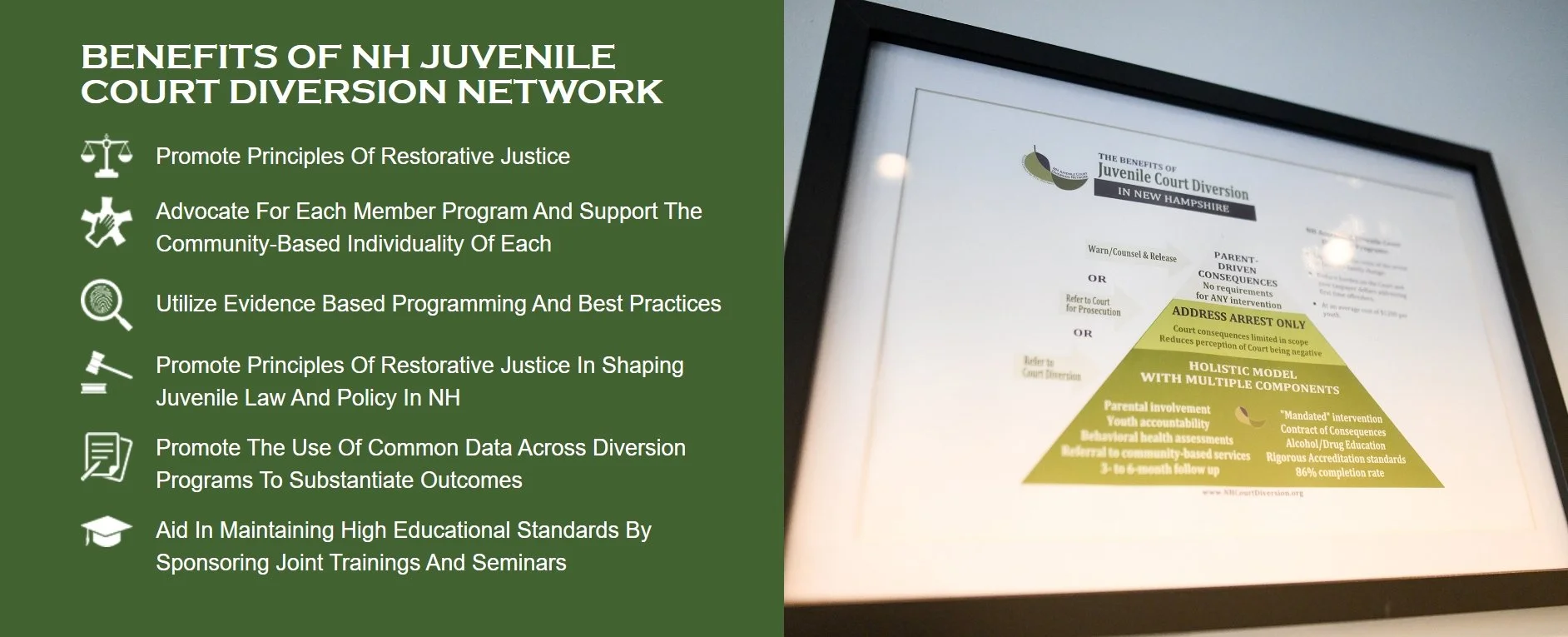
Via the NH Juvenile Court Diversion Networks’ homepage.
For New Hampshire’s accredited diversion programs, that definition includes restorative practices that address the harm done, motivational interviewing to support behavior change, and screening for mental health and substance use needs.
Cannon notes that more than 60% of youth referred to diversion programs screen positive for mental health challenges and substance use.
Importantly, diversion is now the preferred first option for most youth encounters with law enforcement, for a variety of charges. And thanks to statewide juvenile justice transformation efforts completed in 2022, young people can participate in diversion more than once, acknowledging real-life changes in circumstances, development, and risk.
“A 13-year-old and a 17-year-old are entirely different developmentally,” Cannon highlighted. “Why shouldn’t they get another opportunity to make amends and move forward? They grow, their situations might change, and diversion recognizes that.”
“A 13-year-old and a 17-year-old are entirely different developmentally. Why shouldn’t they get another opportunity to make amends and move forward? They grow, their situations might change, and diversion recognizes that.”
How the NH Juvenile Court Diversion Network Works
While the NH Juvenile Court Diversion Network does not run diversion programs itself, it provides accreditation, oversight, training, and financial support so that local programs across the state can do the on-the-ground work.
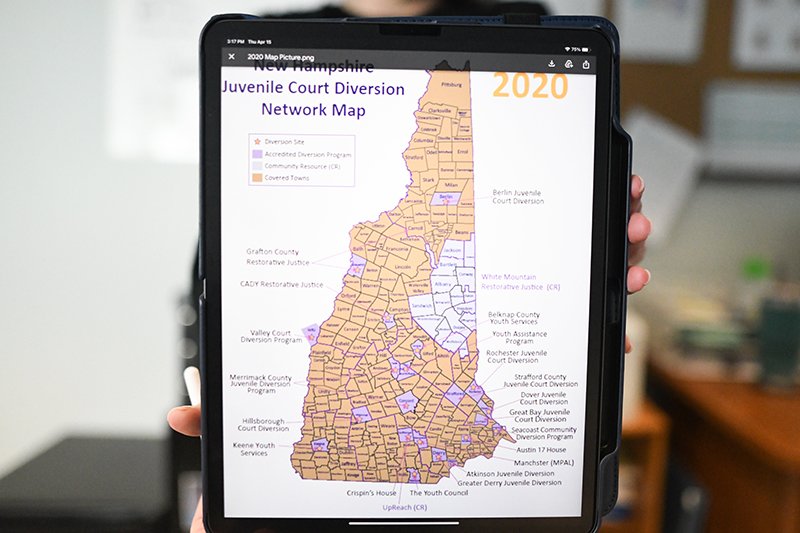
Image from NH Juvenile Court Diversion webpage.
Member programs can be structured as independent nonprofits, municipal entities, county programs, or even police department-affiliated organizations. The Upper Room in Derry, for example, operates its diversion program within a Family Resource Center, meaning that when a youth's needs are identified during the diversion process, they can access services like anger management, parenting support, and family counseling under the same roof.
In Manchester and Nashua, Police Athletic League (PAL) programs offer diversion within a space already dedicated to after-school activities and positive engagement with law enforcement. Youth can work through their diversion requirements while also participating in community programming alongside peers.
Municipal programs like the City of Keene Youth Services and Dover Teen Center, operated by the Dover Police Department, connect youth with structured activities and recreational opportunities that reduce the chances of future involvement with law enforcement. Merrimack County's program deploys two county navigators who ensure that youth can be connected to appropriate local resources regardless of where they live.
“What I love about this network is that programs reflect their communities and are built on the belief that youth deserve support, not a criminal record,” Cannon emphasized. "We know that having these options available for youth to be active and engaged in their community reduces the chances of them recidivating.”
“What I love about this network is that programs reflect their communities and are built on the belief that youth deserve support, not a criminal record. We know that having these options available for youth to be active and engaged in their community reduces the chances of them recidivating.”
An Alternative Path With Proven Results
Last year, the statewide completion rate of youth court diversion programs was over 90% across delinquency and violation-level cases. Additionally, a six-cohort recidivism study (2012–2020), which tracked youth one and three years after diversion, found that New Hampshire’s participants reoffend at rates well below national averages.
“That tells us the model is working,” Cannon said. “Youth aren’t returning to the court system. They’re making amends, addressing the root causes of their behavior, and moving forward.”
And since youth can now participate in diversion more than once, the NH Juvenile Court Diversion Network is preparing a new study that will redefine recidivism to align with the state’s reformed probation and assessment system.
“That tells us the model is working. Youth aren’t returning to the court system. They’re making amends, addressing the root causes of their behavior, and moving forward.”
Equity and Access in NH’s Diversion System
These strong outcomes have helped solidify diversion as a central component of New Hampshire’s juvenile justice system, but questions about equity mirror the broader criminal justice system. As NHCJE has previously reported, incarceration in New Hampshire disproportionately affects Black and Brown residents, and diversion referrals, anecdotally, show similar disparities. However, identifying exactly where inequities occur is difficult because New Hampshire lacks consistent data on first-contact decisions by law enforcement.
"That critical moment of discretion, whether a law enforcement officer gives a youth an informal warning and sends them home, or escalates the encounter by filing a petition, is not tracked uniformly across New Hampshire's many law enforcement agencies,” Cannon explained.
To address this, the NH Juvenile Court Diversion Network convened a Center for Youth Justice (CYJ) team, modeled on Georgetown University’s capstone approach and spanning the entire referral pipeline. This includes law enforcement, juvenile prosecutors, JPPO supervisors, program coordinators, and Cannon herself. Together, they are working to develop training for both police officers and prosecutors on equitable referral practices, identify gaps in geographic access (particularly for rural communities), and have a long-term goal of eliminating program fees so diversion is financially accessible to all families.
Building Community Support for Youth Diversion
While policy reforms and training are key to strengthening equity and access, Cannon says diversion ultimately depends on community involvement. Beyond financial barriers to participation in diversion programs, awareness remains a major challenge. “People don’t know this option exists,” Cannon said. “They don’t know there’s a program in their community.”
Residents can volunteer on panels, mentor young people, partner on community engagement opportunities, serve on nonprofit boards, or offer space and support to local diversion programs. “We need organizations willing to empower our youth,” she said. “Yes, they make mistakes. But they deserve guidance, connection, and the chance to grow.”
Looking ahead, Cannon sees great promise as the Granite State continues its juvenile justice transformation. In a state striving to advance equity and improve youth wellbeing, diversion stands out as a community-rooted, effective tool for helping young people build meaningful connections, purpose, and a restorative path forward.
“We need organizations willing to empower our youth. Yes, they make mistakes. But they deserve guidance, connection, and the chance to grow.”
A full map of diversion programs is available at the NH Juvenile Court Diversion Network's website:
View the NH Juvenile Court Diversion Network’s one-pager:
About Alissa Cannon

Alissa Cannon
Executive Director, NH Juvenile Court Diversion Network
Alissa Cannon is the Executive Director of the New Hampshire Juvenile Court Diversion Network, where she leads statewide efforts to expand diversion programs and strengthen opportunities for youth. With more than 15 years of experience in education, community health, and juvenile justice, she focuses on building collaborative systems that promote accountability, equity, and prevention. Alissa holds degrees in Psychology and Behavioral Science and a certificate in Nonprofit Management. She has led national projects on diversity and workforce development through the New England Prevention Technology Transfer Center and serves as Vice Chair of New Hampshire Outright while contributing to multiple statewide advisory groups on behavioral health and juvenile justice.