
Childcare in New Hampshire: Building a State Where Families Can Thrive

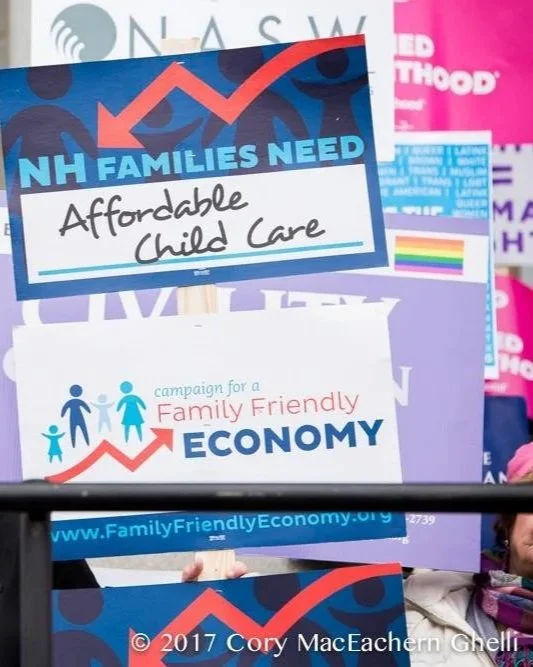
MomsRising NH in Concord, 2017. Image by Cory MacEachern Ghelli. Source: MomsRising blog.
New Hampshire has a childcare crisis. The state's childcare system is underfunded, inequitable, and increasingly inaccessible, and without meaningful investment, it will continue to strain household stability and weaken the broader economy. The consequences are visible: waitlists that start before pregnancy, parents returning to work too soon, and families forced to choose between a paycheck and childcare.
For MacKenzie Nicholson and Nancy Glynn, the New Hampshire Co-Senior Directors of MomsRising, the issue is personal. Both began as volunteer storytellers, sharing their own experiences as mothers navigating gaps in paid leave, healthcare, and childcare. Today, they lead grassroots advocacy efforts focused on early care and education (ECE), maternal health, workplace justice, and family policy in the Granite State.
A Structural Shortage Overlooked by the State
New Hampshire has an average annual shortage of about 9,000 childcare slots for children under six with at least one working parent, based on 2019-2023 data reported by the NH Fiscal Policy Institute. That gap reflects both a decline in supply and a lack of public investment.
“We have a deficit of childcare slots because the number of programs in New Hampshire has steadily declined over the past few years, especially after COVID,” Nicholson explained. “We only invest in childcare as far as the federal government requires us for the programs we provide.”
“We only invest in childcare as far as the federal government requires us for the programs we provide.”
With minimal state investment, rising operational costs are passed directly to families. For two children under four, annual early care tuition can approach $32,000. In many cases, this means that families have to weigh a second income against the cost of childcare. “The math doesn’t work for many families,” Nicholson said. “And more often than not, moms tend to be the ones who choose to leave the workplace.”
The long-term consequences for women and caregivers translate into reduced lifetime earnings, lost retirement contributions, and persistent pay gaps. In 2024, New Hampshire women earned 81% of what men were paid, and that gap is wider for people of color.
“The math doesn’t work for many families. And more often than not, moms tend to be the ones who choose to leave the workplace.”
graphs (on the right) are sourced from new-futures.org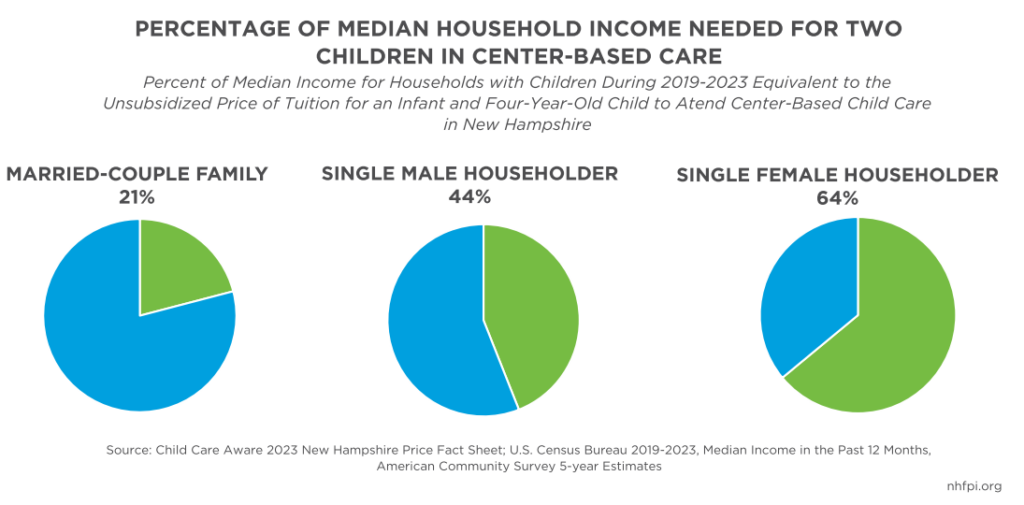
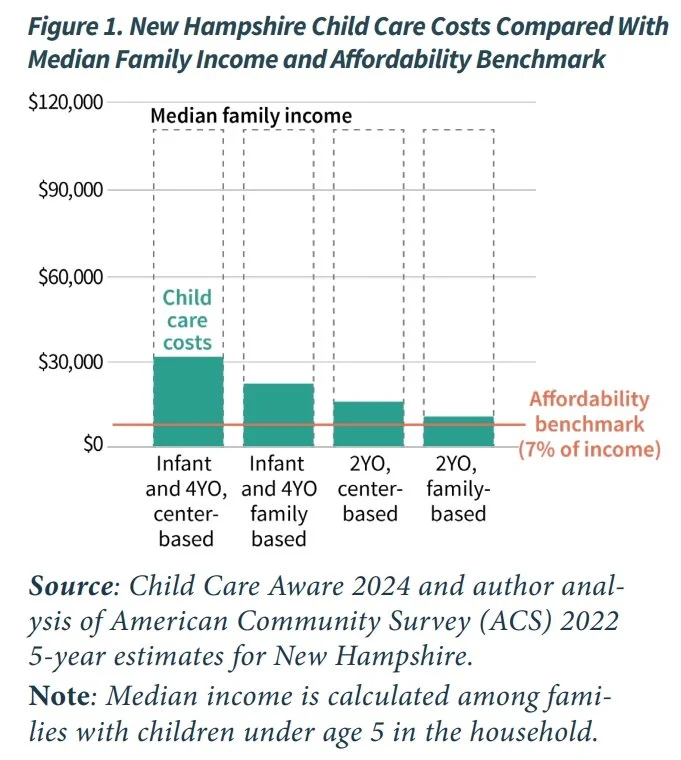
Source: High Child Care Costs Strain NH Family Budgets | Carsey School of Public Policy
Additionally, the childcare workforce itself is under strain. Nicholson noted that the average hourly wage for childcare providers in New Hampshire is around $13, far below the estimated livable wage of approximately $22 per hour. “It’s really hard to pay people a livable wage when, to pay that wage, you have to charge families more in tuition,” she said.
“It’s really hard to pay people a livable wage when, to pay that wage, you have to charge families more in tuition.”
Although a few childcare-related bills have circulated in the current legislative session – such as business tax credits for centers to expand and adjustments to local zoning barriers for family childcare – Nicholson believes they overlook the core solution. “We hear legislators say they’ll tackle the top issues for families, which are housing, childcare, and healthcare, but these proposals fall short,” she said. “We need investment in the system. That's it.”
“We need investment in the system. That’s it.”
An Invisible Population: Children with Disabilities
For Glynn, the childcare crisis is compounded by disability access. Her son, born eight weeks early, received early intervention services and didn't have spoken language until he was about six years old.
“I couldn’t put my son in childcare, even if I wanted to,” Glynn said. “There aren’t a lot of childcare options, if any, available for children with disabilities where they can truly get the care they need.”
Early intervention services (birth to age three) require coordinated care across providers and home environments. While effective programs exist, they are not consistently or widely available. Few childcare programs are equipped to integrate that level of support, and accessing them privately can be prohibitively expensive. As a result, many parents of children with disabilities have to leave the workforce or work irregular hours to meet their child’s needs.
“We are still leaving out an entire marginalized community,” Glynn noted. “Families that experience disability are more likely to experience poverty due to additional medical and support costs, and inaccessible childcare deepens that vulnerability.”
“Families that experience disability are more likely to experience poverty due to additional medical and support costs, and inaccessible childcare deepens that vulnerability.”
Workplace Justice and Economic Development
The childcare shortage intersects directly with workplace justice. Although New Hampshire has a voluntary paid family leave program, participation rates remain limited. “It was crafted in a way that’s not sustainable,” Nicholson stated. “Only businesses that choose and can afford to opt-in benefit. This leaves out small businesses, which make up the majority of employers in our state,” she added. A mandatory, statewide paid family leave program would establish a more equitable baseline.
Glynn added that nonprofits, which are key service providers and employers across the state, are rarely centered in the conversation. “The state relies heavily on nonprofits to deliver services, but they’re not putting forward policy to support them,” she stated.
Furthermore, both Nicholson and Glynn also framed childcare as an economic infrastructure issue. While New Hampshire frequently promotes itself as business-friendly, without childcare, workers can't work, and businesses can't attract or retain employees, especially young talent.
"We can't say we want businesses to move into the state if we don't even have the infrastructure for the building itself or the workforce to back it up," Glynn added.
“The state relies heavily on nonprofits to deliver services, but they’re not putting forward policy to support them . . . We can’t say we want businesses to move into the state if we don’t even have the infrastructure for the building itself or the workforce to back it up.”
Representation and Participation Matters
Legislative demographics matter, too. Limited compensation and structural barriers can reduce representation from working parents in the legislature. It is difficult for anyone who has a job and other commitments to be able to hold office, which is why much of the legislature is made up of retired individuals, not people in working families. “If you haven’t navigated the childcare crisis in the last five or ten years, it’s hard to understand what it looks like today,” Glynn emphasized.
At the same time, her work at MomsRising gives her hope. “We are seeing more people speaking out, and folks are not feeling as isolated as they did before,” Glynn said. "It's a matter of having the right brainstormers, the right thinkers, and the right activators to be able to go out and make it happen.”
As a grassroots movement, MomsRising welcomes people at every level of engagement. Writing letters to the editor, providing childcare so a parent can attend a hearing, or sharing a story with a neighbor are some examples of participation. “Sometimes it’s even holding someone’s hand because it’s their first time in a hearing,” Glynn said.
Nicholson underscores that engagement can begin informally. “There are many different roles, even in ways that might not feel like taking action,” she said. “Find an organization that works on issues you care about and get involved.”
“It’s a matter of having the right brainstormers, the right thinkers, and the right activators to be able to go out and make it happen.”
Political Will and Long-Term Investment in Childcare
The remaining question is political will. It’s well-documented that positive economic and child development outcomes occur when early childhood systems are adequately funded. As Glynn put it: “We need to think long term, strategically, about how all these things are connected.”
High-quality, affordable childcare is not a standalone issue. It is inseparable from workforce stability, economic development, gender equity, and disability access. Without sustained public investment, the network of providers will continue to shrink, costs will remain out of reach for many families, and workforce participation, particularly among women, will decline.
The answers have already been laid out for New Hampshire. Whether families are set up to thrive will depend on the state’s response.
Learn more about MomsRising: momsrising.org/NH
“There are many different roles, even in ways that might not feel like taking action. Find an organization that works on issues you care about and get involved.”
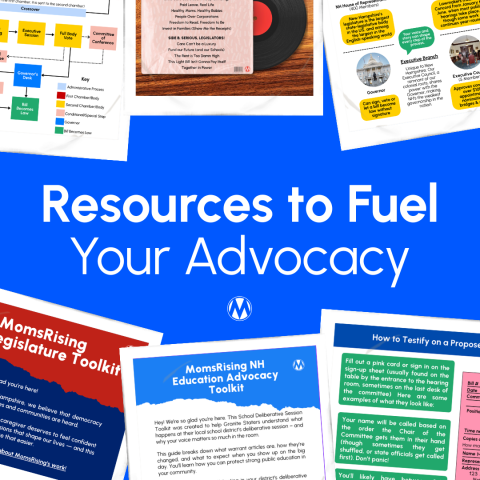
Get involved - MomsRising NH Resources:
‘Who is my NH legislator?’ Regional Toolkits:
_____________________
NH ECE Research & Data:
Publications & Research- NH ECE Research Consortium
Children’s Health Dashboard - NH Children’s Health Foundation
Equity in Early Care and Education Fact Sheet - Black Lives Matter New Hampshire
NH Child Well-Being Data Hub - Endowment for Health
NH Kids Count Statewide Data - New Futures
Community Research Findings | Equity in Family Services Report - Endowment for Health & Child Trends
Additional NH ECE Resources:
Early Care and Education Division - Black Lives Matter New Hampshire
Early Childhood Equity Movement - Endowment for Health & Child Trends
The NH Alliance of Early Childhood Coalitions
_____________________
About MacKenzie Nicholson & Nancy Glynn

MacKenzie Nicholson serves as Co-Senior Director for MomsRising New Hampshire, where she works alongside an incredible group of moms and caregivers using their voices to make NH a better place for everyone. A lifelong Granite Stater, Kenz earned her BS in Family Studies and MS in Public Policy from UNH. After becoming a mom, she spoke out about her lack of paid leave and testified in both the State House and Congress as a MomsRising volunteer. She was elected to her town’s School Board in 2026 and loves reading banned books and hanging at the beach with her two kids!
Nancy Glynn - Born in Exeter and rooted in North Sutton, Nancy is a community organizer, U.S. Navy veteran, and storyteller committed to grassroots leadership. The daughter of a Korean mother and a proud mom, she’s a graduate of UNH’s Institute on Disability Leadership Series and has mentored families and people with disabilities statewide. Nancy serves her community as Selectwoman for Sutton, a member of the local school board, and chair of the Sutton Free Library Board. As Co-Senior Director for MomsRising New Hampshire, she has led fellowship programs since 2018 and mentored hundreds in relational, values-based organizing.